Stone Milling, Answered: The Questions Mill Owners Ask Us Most
Stone Milling, Answered: The Questions Mill Owners Ask Us Most
We have been making emery millstones and flour mills in Nawa City, Rajasthan since the 1950s, and now exporting to over 22 countries. The same questions come back year after year — from a first-time atta chakki buyer, from a teff miller in Ethiopia, from bakery owners, from a packaged-flour brand deciding whether stone milling is worth the trouble.
Some of the answers are not what the marketing in this industry would lead you to expect.
How stone milling works
What is stone milling?
Grain is ground between two stones. One is stationary — the bed stone. The other rotates — the runner stone. Grain enters through an opening at the centre, travels outward through grooves cut into the facing surfaces, and leaves at the rim as flour. The gap between the two stones sets the fineness.
The principle is ancient. What has changed is the stone. Modern mills use manufactured emery stones rather than quarried rock, which means grade, grit and bond can be held consistent from one stone to the next instead of depending on what a quarry happened to yield.
What is an emery millstone actually made of?
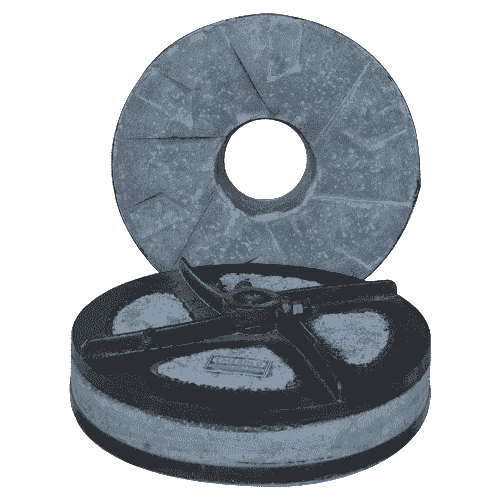
Emery is an abrasive mineral. A millstone is made by bonding emery grain into a disc — commonly by the oxychloride process, using magnesite — and then cutting grooves into the grinding face.
Two families are in common use:
- Black emery, made from synthetic emery
- Red emery, made from natural jasper stone
We make both, in sizes from 200 mm to 1200 mm. Pukhraj stones are made from syncro-grained abrasives with reinforcement technology, at a hardness of up to 8.5 on the Mohs scale.
Flour quality and nutrition
This is where most of the misinformation lives, so these answers are longer.
Is stone-milled flour really more nutritious?
More honest than the usual claim: stone-milled flour is genuinely whole grain, but that is a consequence of the process, not a nutritional property of stone itself.
A stone mill grinds bran, germ and endosperm together in a single pass, so everything in the kernel ends up in the flour by default. A roller mill separates the grain into streams, and the refined white flour that results has had the bran and germ removed — which is the real nutritional difference most people are pointing at.
Does stone milling keep the flour cool?
It can. It does not automatically. Pukhraj Cold Pressed Flour Mill is designed to keep the flour / spices cool.
Heat in a stone mill is a function of how you run it — rotational speed above all, plus feed rate, grain moisture and the condition of the stone face. When researchers milled chickpea at different stone speeds, flour temperature, power draw and starch damage all rose significantly as speed increased (Cappelli et al., Applied Sciences, 2023, 13(19):11084). A broader study across mills running from 65 to 40,000 rpm found the same pattern: maximum flour temperature rose with rotational speed and tangential velocity (Ross et al., Cereal Chemistry, 2018).
The practical conclusion: cool flour comes from a mill designed and operated to run cool — lower rpm, correct feed rate, a stone in good condition — not from the word "stone" on the invoice. This is precisely why low-rpm and cold-pressed designs exist, and why the same stone in two differently set-up mills will give you two different flour temperatures.
Why does my stone-ground flour absorb more water than roller-milled flour?
Because of starch damage. Grinding between stones ruptures more starch granules, and damaged starch takes up more water.
The same Italian group measured this and found stone-milled wholegrain flours had significantly higher damaged starch than roller-milled ones in every case tested (Carcea et al., Foods, 2022, 11(3):339). Higher water absorption is not automatically bad — it changes dough behaviour and yield, and bakers adjust for it — but if your dough is behaving differently after a switch to stone-ground flour, this is usually why.
Why does stone-ground atta go rancid faster?
Because the germ is in it. Germ contains oils, those oils oxidise, and once the germ is distributed evenly through the flour there is a great deal of surface area for that to happen on.
Refined roller-milled flour has had the germ taken out, which is exactly why it keeps for months. Shorter shelf life is the cost of whole grain, not a defect in your stones. Store flour cool and dry, mill closer to when you sell, and set customer expectations rather than promising a shelf life the product cannot hold.
Introducing Sun Flour Finisher - designed to add more life to your stone milled flour.
Is phytic acid removed by stone milling?
No. Phytic acid sits mainly in the bran, so any wholegrain flour contains it regardless of how it was milled. Researchers found no difference in phytic acid between stone-milled and roller-milled flour when all the roller streams were recombined (Carcea et al., 2022).
Is stone-milled flour safe? Does stone wear end up in the food?
Emery millstones have been the standard in commercial grain milling worldwide for generations.
If you are seeing visible grit in your flour, the usual cause is not the stone. It is uncleaned grain. Check the destoner and the magnet before you blame the stones, then inspect the stone face for pitting.
The stones themselves
How long does a set of stones last?
Longer or shorter than you would like, and anyone who gives you a number without asking questions first is guessing.
Stone life depends on the grain, how clean it is, hours run, fineness, speed and the grade of stone.
The useful number is not somebody else's, though. Track hours per set of stones in your own mill. When that number drops, something has changed — usually the grain, the cleaning, or the setting.
What is stone dressing, and how often is it needed?
Dressing means re-cutting the grooves in the grinding face once wear has shallowed them. Worn grooves stop moving material outward efficiently, so capacity falls and the flour goes coarse or the mill starts heating.
Published intervals vary a great deal. On how many times a stone can be re-dressed, figures across the industry run from about three to eight — including different figures in different places on the same manufacturer's own website — because it genuinely depends on stone thickness, grade and duty.
For your stones, ask your own supplier for the minimum safe remaining thickness on your specific size and model, and treat that as a hard limit. Running a worn stone past it at operating speed is a safety issue, not an economy.
Does the groove pattern change depending on what I am grinding?
Yes. Groove design and dressing are specified for the material. A stone dressed for fine atta will not give the best result on coarse maize meal, and oily or fibrous material behaves differently again.
If you switch between very different products on one machine, say so before you order rather than after.
What size stone do I need?
Stone size is set by the machine and the throughput, not by preference. A larger stone is not automatically better — it means more power and more weight.
When ordering a replacement, send diameter, thickness, the fitting or bolt-hole dimensions, the make and model of the mill, the operating speed and motor rating, what you grind, and photographs of the worn face taken straight on. That is enough to get it right the first time.
Running the mill
Can one stone mill grind more than one product?
Yes, and it is one of stone milling's real advantages. Wheat, maize, millet, sorghum, teff, pulses, spices, coffee and herbal material can all be ground on stone. The limit is the dressing and the grade, as above — not the machine.
Is stone milling the right choice for teff and injera flour?
The evidence is unusually clear here. When researchers compared injera made from teff flour ground on disc, hammer and blade mills, the disc-milled flour scored highest for overall acceptability — 6.6, against 4.2 for hammer-milled and 4.1 for blade-milled (Assefa et al., Food Chemistry, 2018, 266:155–160). The disc mill also produced the finest particle size, and the authors note this is why disc mills are commonly used for teff in Ethiopia in the first place.
Teff flour needs to be very fine and should not feel gritty between the fingers. That is a dressing and grade question, and worth discussing before ordering.
My output has dropped and the flour has gone coarse. What is wrong?
In rough order of likelihood: the stone face has dulled or glazed and needs dressing; the setting has drifted; the feed is uneven or surging; grain moisture has changed; or the stones are no longer running true to each other.
The mistake to avoid is tightening the mill further to compensate for a stone that has lost its cut. That is the fastest way to ruin a second stone straight after the first.
Do you supply spare parts, and do you ship internationally?
Yes to both. Spare parts are a large part of what we do — stones, fitments, bearings and machine parts — and we ship to more than 22 countries.
Send your machine details and photographs of the worn stone face to sales@pukhrajmillstone.com or WhatsApp +91 96364 11526, and our technical team will tell you what fits.